


Barbell Landmine Row
A single-arm row of a barbell anchored at one end, pulling the loaded sleeve to the hip from a hinged stance.
- Main muscle
- Upper back
- Also works
- BicepsRear deltsTrapsAbs
- What you need
- Barbell
- Level
- Beginner
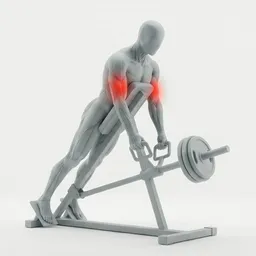
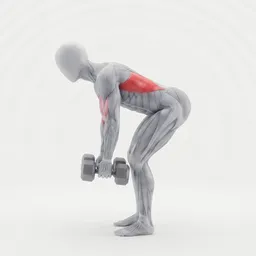
A landmine row uses a barbell with one end in a sleeve or corner so the loaded end travels in an arc. You hinge, grab the shaft just behind the plates with the near hand, brace the other hand on the thigh, and row the elbow back until it passes the midline, then lower under control. A Meadows row is the same landmine setup: unilateral, overhand, pulling toward the hip, with the upper back as the target and biceps, lats, and trunk assisting. The bent-over row is the bilateral cousin: hinge, long spine, pull to the body.
How to do it
- 1Wedge one end of a barbell into a landmine sleeve or a padded corner and load the free end.
- 2Hinge at the hips with a soft knee bend and stand beside the loaded sleeve.
- 3Grip the shaft just behind the plates with the near hand and brace the opposite hand on the thigh.
- 4Row the elbow back and up until it is at or just past the midline of the torso.
- 5Lower the sleeve under control until the arm is long, without rounding the back.
- 6Finish the set, then switch sides and match the same range.
Common mistakes
- Using a hip swing to yank the sleeve instead of rowing with the back.
- Letting the low back round as the arm reaches long.
- Turning the lift into a biceps curl by leaving the shoulder blade stuck.
- Standing too upright so the arc never loads the lats.
Why do it
- Rows one side at a time so left-to-right gaps show up immediately.
- The fixed arc is easier on the low back than a free barbell row for some lifters.
- Uses a standard barbell plus a sleeve, so it does not need a dedicated T-bar.
Similar exercises
Same muscles, other equipment. Handy when your machine is taken.


Track it in Gymaroo
Log your sets, see your last weight next to every set, and watch the Barbell Landmine Row climb. Free on iPhone and Android.