


Freestyle Swim
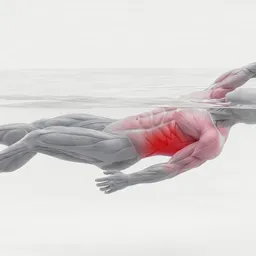
Prone alternating-arm swimming with a flutter kick and rotational breathing, driven by the back and chest through each pull.
- Main muscle
- Cardio
- Also works
- LatsMid & lower chestTricepsFront deltsAbsBiceps
- What you need
- BodyweightDone for time
- Level
- Intermediate
Front crawl is the fastest and most studied stroke. Roughly eighty five percent of propulsion comes from the arms, and the muscles measured most often in underwater EMG work are triceps brachii, pectoralis major, latissimus dorsi and biceps brachii, with rectus abdominis and erector spinae stabilizing the body line. One arm pulls with a high elbow while the other recovers over the water, the body rolls along its long axis to set up each catch, and a flutter kick from the hips holds the legs high. Breathing comes every two or three strokes as the hand exits.
How to do it
- 1Float face down with your body straight and horizontal in the water.
- 2Reach one arm forward and set the catch with the elbow held high.
- 3Pull that hand down and back past your hip while the body rolls toward it.
- 4Recover the arm over the water as the opposite arm begins its pull.
- 5Kick continuously from the hips with loose ankles and a small knee bend.
- 6Turn your head to inhale every two or three strokes as the hand exits.
Common mistakes
- Dropping the elbow at the catch, which spills water and loses the pull.
- Lifting the head to breathe instead of rotating, which sinks the hips.
- Kicking from the knees, which adds drag rather than propulsion.
- Crossing the hand over the midline at entry, which pushes the shoulder to end range.
Why do it
- Trains back, chest and arms through a repeatable overhead pull.
- Builds aerobic capacity with no ground impact at all.
- Transfers directly to triathlon and open water programming.
Similar exercises
Same muscles, other equipment. Handy when your machine is taken.

Track it in Gymaroo
Log your sets, see your last weight next to every set, and watch the Freestyle Swim climb. Free on iPhone and Android.