


Step-Down to Balance
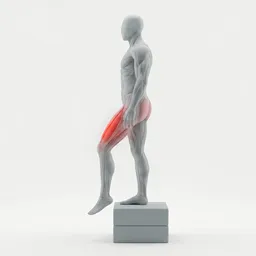
A single-leg lower off a small block: the free heel hovers just above the floor, then the stance leg stands back up.
- Main muscle
- Quads
- Also works
- Glute max
- What you need
- Bodyweight
- Level
- Intermediate
Step-down to balance is a slow single-leg lower that brings the free forefoot to the floor. A rehab article treats anterior step-downs as a staple for eccentric knee control, with the stance leg's glutes and quads taking the descent. A bodyweight roundup describes the same lower: stand on a low step, bend the stance knee, drop the free heel toward the floor, and stand back up without handing the work to the free foot.
How to do it
- 1Stand on a low, stable block with one foot fully on it and the other foot free.
- 2Clasp the hands in front of the chest and level the hips.
- 3Bend the stance knee just enough to lower the free heel to a hover above the floor.
- 4Let the free toes point down so the forefoot can reach the floor.
- 5Straighten the stance knee to return to the tall start without hopping.
- 6Stay on the same stance leg for the set, then switch.
Common mistakes
- Pushing off the free foot to stand back up instead of using the stance leg.
- Dropping the opposite hip as the stance knee bends.
- Letting the stance knee cave inward off the second toe.
- Turning the drill into a high-knee march instead of a small, controlled lower.
Why do it
- Trains eccentric knee control on one leg without a heavy load.
- The hover keeps balance in the drill, which a tap-and-go step-down can skip.
- Uses a very low block, so it fits rehab-style progressions before a full box.
Similar exercises
Same muscles, other equipment. Handy when your machine is taken.
Track it in Gymaroo
Log your sets, see your last weight next to every set, and watch the Step-Down to Balance climb. Free on iPhone and Android.